

Beyond the Autocomplete: Why “AI Software Engineers” Are the Real Revolution
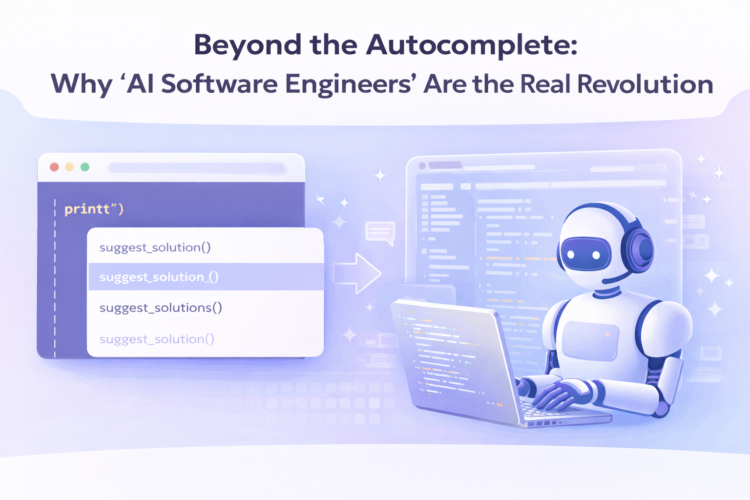

The era of “GitHub Copilot as a sidekick” is evolving into the era of “AI as a lead developer.” But what exactly changed? Why is every major VC firm in Silicon Valley suddenly obsessed with “Agentic IDEs”? Let’s break down the next phase of how software is born.
The Core Difference: The Advanced Calculator vs. The Lead Architect
To understand this leap, we have to look at the limitations of the tools we’ve used over the last few years.
- Standard AI Coding Assistants (Copilot, early ChatGPT) are like Advanced Calculators. They are incredibly fast at finishing a sentence or generating a “boilerplate” function. However, they lack “Global Context.” They don’t know why you are building the feature; they only know how to complete the line of code you are currently typing. You are the brain; they are the fingers.
- AI Software Engineers (Devin, OpenDevin, Cursor Agents) are like Senior Lead Architects. You don’t give them a line of code; you give them a GitHub Issue, a Jira ticket, or a vague business requirement. They don’t just type; they think. They can clone a repository, analyze the entire file structure, plan a multi-file migration, and—most importantly—debug their own mistakes without you pointing them out.
The “Loop”: How an AI Engineer Actually Builds
An autonomous AI engineer doesn’t just generate text; it operates within a “Reasoning Sandbox.” Unlike a chatbot that gives a one-shot response, an AI Engineer follows a sophisticated cognitive loop:
- Exploration & Context Mapping: The agent first “reads” your entire codebase. It builds a map of how the database interacts with the frontend and where the API endpoints live.
- Strategic Planning: Before writing a single line, the AI creates a technical roadmap. It decides which files need to be created and which dependencies must be installed.
- Execution & Tool Use: The AI opens a terminal, runs npm install, creates files, and writes code. It literally uses the same tools a human developer uses.
- Self-Correction (The Feedback Loop): This is the breakthrough. The AI runs the code it just wrote. If it sees an error in the console, it doesn’t wait for you to fix it. It reads the error log, realizes its mistake, and rewrites the code.
- Validation: It writes and runs its own unit tests to ensure the new feature hasn’t broken the existing system before finally presenting you with a Pull Request.
A Scenario: The 2027 "One-Person Unicorn"
Imagine you are a founder with a vision for a complex Fintech app.
- The Old Way (2022): You hire a CTO, two backend devs, and a frontend specialist. You spend 6 months and $150,000 just to get a Beta version. You spend 40% of your time in meetings explaining requirements.
- The AI Way (2027): You are a solo founder. You open your Agentic IDE and type: “Build a secure payment gateway that supports crypto-to-fiat conversion and auto-generates tax invoices for EU users.” *
- Hour 1: The AI sets up the cloud infrastructure and database schema.
- Hour 2-4: It integrates 3 different APIs, handles the encryption logic, and builds a responsive dashboard.
- Hour 5: It performs a security audit on its own code.
- Result: By the evening, you have a production-ready MVP. You didn’t write code; you orchestrated a system.
Content Reasons Block (Why Move to AI Engineering?)
- Massive Productivity Gains: AI engineers can handle “boring” tasks like migrations, documentation, and unit testing 10x faster than humans.
- Lower Barrier to Entry: Non-technical founders can now build and maintain complex software without needing a massive initial budget.
- Legacy Code Modernization: AI agents are perfect for reading “spaghetti code” from 10 years ago and refactoring it into modern, clean frameworks in minutes.
Autonomous AI Coders
- Works 24/7 without fatigue or "burnout."
- Instant context switching between multiple complex projects.
- Drastically reduces the cost of MVP (Minimum Viable Product) development.
- Can automatically find and patch security vulnerabilities.
- If the AI makes a subtle logic error, it requires a high-level expert to spot it.
- Giving an AI agent terminal access requires very strict sandboxing.
- Running high-reasoning models for hours can be expensive for large teams.
- AI can build what you ask for, but it doesn't always understand what users love.
Benchmarks
The Takeaway
We are moving from an era of “Syntax Literacy” (knowing how to write Python or Javascript) to an era of “Architectural Intelligence” (knowing how to design systems and manage AI agents). The developer of the future isn’t the person who can type the fastest or memorize the most libraries—it’s the person who can best define the problem and supervise the AI “employees” who solve it. The keyboard is becoming optional; the vision is becoming everything.
Related Posts

If 2023 was the year we learned to talk to machines, 2026 is the year...

The panic of 2024 has settled into the pragmatism of 2026. Two years ago, the...

The landscape of Large Language Models (LLMs) has shifted dramatically in the last six months....