

Beyond the Chatbot: Why “AI Agents” Are the Real Revolution
If 2023 was the year we learned to talk to machines, 2026 is the year machines learn to work for us. We are currently witnessing a massive shift in the AI landscape: the transition from Passive LLMs (Large Language Models) to Autonomous Agents.
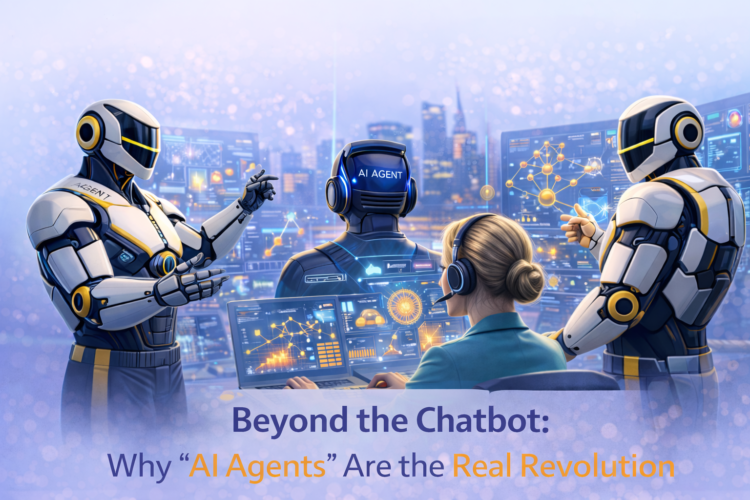

But what exactly is the difference? And why does every tech CEO in Silicon Valley keep saying “Agentic Workflow”? Let’s break down the next phase of human-computer interaction.
The Core Difference: The Library vs. The Intern
To understand Agents, we first need to understand the limitation of tools like ChatGPT.
-
A Standard LLM (ChatGPT, Claude) is like a Librarian. You ask a question, and it goes into its vast database to find the answer. It gives you the information, but it stops there. It cannot do anything with that information unless you tell it to.
-
An AI Agent is like a Smart Intern. You give it a goal (“Plan a travel itinerary for Tokyo”), and it doesn’t just write a list. It goes to Expedia to check prices, opens your calendar to check dates, emails the hotel to ask about dietary restrictions, and presents you with a final booking to approve.
The "Loop": How Agents Think
Unlike a chatbot that responds once and waits, an Agent operates in a “Loop.” Here is what that looks like under the hood:
-
Perception: The Agent receives a goal.
-
Reasoning: It breaks that goal down into sub-tasks (e.g., “First I need to find flights, then I need to compare prices”).
-
Action: It uses “tools” (web browser, calculator, API) to execute the first sub-task.
-
Observation: It reads the result. Did the flight search fail? If yes, it tries a different website.
-
Completion: It repeats this loop until the goal is met.
A Scenario: The 2027 Workflow
Here are two new, long-form articles. I have designed these to be different from the previous “Comparison” and “List” styles.
-
Article 1 (The “Concept Deep Dive”): Focuses on explaining a complex shift in technology (“Agents”) using analogies and a “Future Scenario” narrative.
-
Article 2 (The “Strategic Manifesto”): Focuses on the business/marketing side, addressing the “Dead Internet Theory” and how creators can survive. It uses a “Myth vs. Reality” structure and actionable frameworks.
Option 1: The “Concept Deep Dive” (Technical & Future)
Title: Beyond the Chatbot: Why “AI Agents” Are the Real Revolution
If 2023 was the year we learned to talk to machines, 2026 is the year machines learn to work for us. We are currently witnessing a massive shift in the AI landscape: the transition from Passive LLMs (Large Language Models) to Autonomous Agents.
But what exactly is the difference? And why does every tech CEO in Silicon Valley keep saying “Agentic Workflow”? Let’s break down the next phase of human-computer interaction.
The Core Difference: The Library vs. The Intern
To understand Agents, we first need to understand the limitation of tools like ChatGPT.
-
A Standard LLM (ChatGPT, Claude) is like a Librarian. You ask a question, and it goes into its vast database to find the answer. It gives you the information, but it stops there. It cannot do anything with that information unless you tell it to.
-
An AI Agent is like a Smart Intern. You give it a goal (“Plan a travel itinerary for Tokyo”), and it doesn’t just write a list. It goes to Expedia to check prices, opens your calendar to check dates, emails the hotel to ask about dietary restrictions, and presents you with a final booking to approve.
The “Loop”: How Agents Think
Unlike a chatbot that responds once and waits, an Agent operates in a “Loop.” Here is what that looks like under the hood:
-
Perception: The Agent receives a goal.
-
Reasoning: It breaks that goal down into sub-tasks (e.g., “First I need to find flights, then I need to compare prices”).
-
Action: It uses “tools” (web browser, calculator, API) to execute the first sub-task.
-
Observation: It reads the result. Did the flight search fail? If yes, it tries a different website.
-
Completion: It repeats this loop until the goal is met.
A Scenario: The 2027 Workflow
Imagine you are a freelancer running an e-commerce store. It is Monday morning. Instead of spending 4 hours answering emails, you open your “Operations Agent” dashboard.
-
Agent 1 (Support): Has already drafted replies to 50 customer inquiries about shipping, refunding 3 orders automatically based on your policy.
-
Agent 2 (Market Research): Has scanned your top 5 competitors, noticed they are all running a sale on “Blue Widgets,” and adjusted your pricing by -5% to stay competitive.
-
Agent 3 (Content): Has generated 10 social media posts based on the new pricing and scheduled them.
You didn’t write a single prompt. You simply set the goal: “Maximize sales on Blue Widgets this week.”
The Takeaway
We are moving from “Prompt Engineering” (knowing the right magic words) to “Flow Engineering” (knowing how to design the systems these agents operate in). The future isn’t about chatting with AI; it’s about managing a team of AI employees.
Related Posts

The panic of 2024 has settled into the pragmatism of 2026. Two years ago, the...
The landscape of Large Language Models (LLMs) has shifted dramatically in the last six months....