

Bots Have Passed Humans in Cloudflare’s Web Traffic Data — What It Really Means
Cloudflare Radar data suggests bots now generate more HTML web requests than humans. The real story is not just bot traffic growth, but how AI agents may reshape the web.

Bots Have Passed Humans in Cloudflare’s Web Traffic Data — What It Really Means
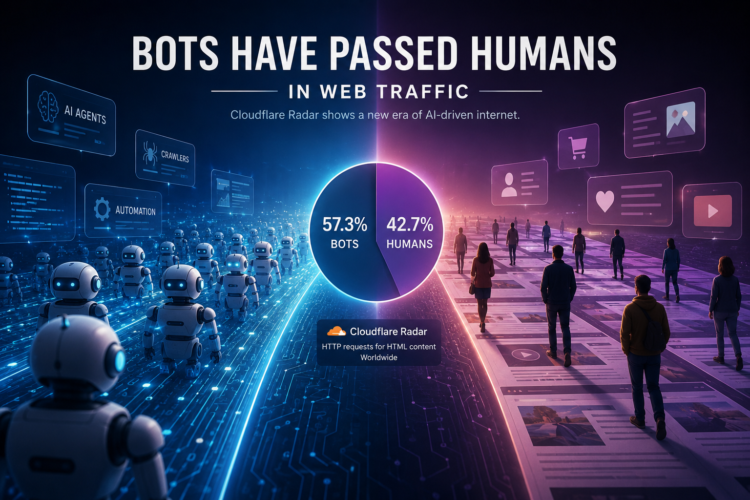
Bots are now generating more web page requests than humans, according to data shown on Cloudflare Radar.
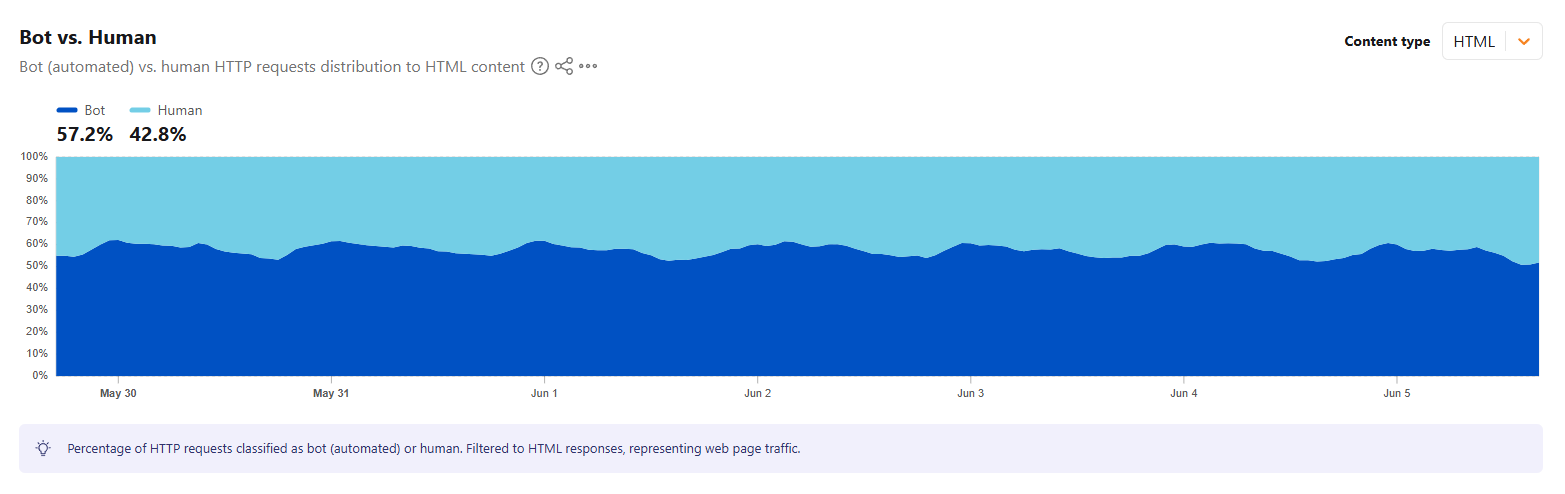
Cloudflare’s public traffic dashboard recently showed automated bot traffic at roughly 57% of worldwide HTML web requests, compared with about 43% from human users. Matthew Prince, Cloudflare’s co-founder and CEO, also commented on X that the shift happened faster than he expected, saying bot traffic had now passed human traffic online.
That sounds like a dramatic moment for the internet — and in many ways, it is. But it is also important to understand what the data actually measures. This does not mean humans have stopped using the internet, or that bots now account for every type of online activity. It means bots are now ahead in a specific but important category: HTTP requests to HTML content. And that distinction matters.
What Cloudflare’s Data Actually Shows
Cloudflare Radar tracks traffic across Cloudflare’s global network. In this case, the key metric is the split between bot and human HTTP requests to HTML content — essentially, requests for web pages.
That is different from total internet usage. Streaming video, mobile app activity, gaming, messaging, and time spent inside closed platforms are not the same thing as page requests. A human might spend 20 minutes watching a video or reading a feed, while an automated system can request hundreds or thousands of pages in the same period.
So the headline should not be simplified to “bots are the majority of the entire internet.” A more accurate reading is: bots are now responsible for the majority of HTML web requests visible in Cloudflare’s data.
That is still a major signal. The open web has always been built around the assumption that most pageviews represent people. That assumption is becoming weaker.
Why Bot Traffic Is Growing So Quickly
Some bot traffic has always existed. Search engines crawl websites. Monitoring tools check uptime. Spam bots submit forms. Scrapers collect data. Security systems scan the web.
What is different now is the rise of AI-driven and agentic traffic.
AI systems increasingly need fresh information from the web. They crawl pages, summarize content, compare products, check prices, collect facts, and prepare answers for users. Some AI agents can go further by completing multi-step tasks, such as researching options, filling forms, or interacting with online services.
This is why the topic is bigger than traditional bot activity. AI assistants are no longer just waiting for users to type questions into a chat box. They are beginning to act as intermediaries between people and websites.
For users, this can be useful. A good AI assistant can help research faster, compare information, and reduce repetitive browsing. For businesses, it creates a more complicated question: what happens when the “visitor” to your website is not a person, but an AI system acting for a person?
Why This Matters for Websites and Analytics
For website owners, marketers, publishers, and SaaS companies, the rise of bot traffic makes web analytics harder to read.
A pageview used to feel like a simple signal: someone visited the page. That was never perfectly true, but it was close enough for many websites. Now, a growing share of traffic may come from automated systems that do not behave like normal users.
That can affect:
- traffic reports;
- conversion rates;
- server costs;
- content strategy;
- SEO decisions;
- advertising performance;
- lead quality.
If AI agents read your product page, summarize your pricing, and recommend your tool to a user without that user ever clicking through, your content may still influence a decision — but the website visit may never look like a traditional marketing journey.
This is especially relevant for AI tool discovery. Directories, comparison pages, and product listings may increasingly be read by both people and machines. A clear page structure, accurate descriptions, useful comparisons, and well-organized data may become even more important.
For example, someone exploring AI automation workflows may not manually open ten different tools. An AI agent could compare options, summarize differences, and suggest whether a workflow platform like n8n or Make fits the user’s needs.
That changes the role of websites. They still need to persuade humans, but they also need to be understandable to machines.
Not Every Bot Is a Useful AI Agent
There is one important caution: not all bots are AI agents, and not all bot traffic is valuable.
Some bots are helpful. Search crawlers, uptime monitors, accessibility tools, and legitimate AI assistants can make the web easier to discover and use. But other bots are low-quality or harmful: spam, scraping, credential attacks, fake signups, ad fraud, and aggressive data collection.
That means website owners should not treat “bot traffic” as one single category. The real challenge is separating useful automated access from unwanted automation.
The future may not be about blocking every bot. It may be about deciding which automated systems are allowed to access content, under what rules, and for what purpose.
The Web Is Not Dead, But Its Traffic Is Changing
The most interesting part of the Cloudflare data is not just that bots passed humans in one traffic metric. It is what that milestone suggests about the next stage of the web. The internet is becoming less human-only.
People will still search, read, watch, buy, and browse. But more of that activity may be supported by AI systems that gather information before the user ever reaches a website. In some cases, the AI may become the main interface, while websites become structured sources of information behind the answer.
For users, this could make the web faster and more convenient. For publishers and businesses, it raises harder questions about visibility, attribution, monetization, and control. The takeaway is not panic. It is preparation.
Websites should keep creating useful content for humans, but they also need to think about how AI systems read and interpret that content. Clear structure, accurate information, strong internal linking, and trustworthy sources are no longer just SEO details. They may become part of how websites remain visible in an agent-driven web.
Bots passing humans in Cloudflare’s web request data is not the end of the internet. But it is another sign that the web is changing from a place people visit directly into a layer that both humans and AI agents navigate together.
Related Posts

A new CDT report identifies 37 dark patterns in AI chatbots — from privacy nudges...