

The Death of the “Blue Link”: Why AI Answer Engines Are the New Search
If 2023 was the year we learned to chat, 2026 is the year we stop "searching" and start "knowing." We are currently witnessing the biggest shift in internet history since the invention of the browser: the transition from Keyword Search to Generative Answer Engines.
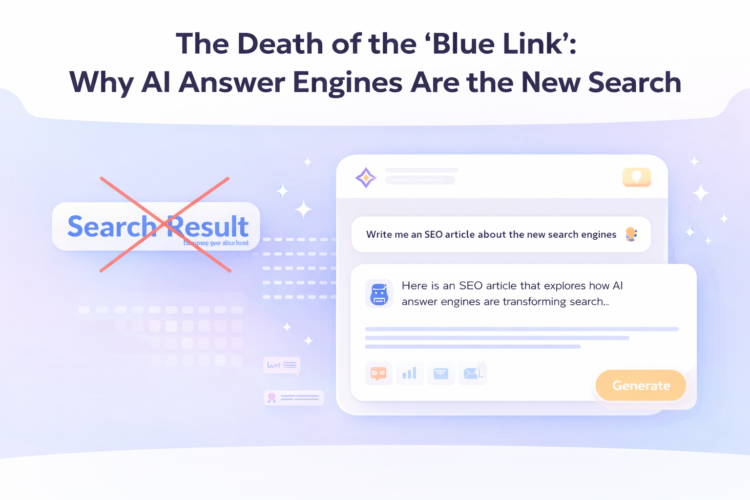

But why is Google’s 25-year reign suddenly at risk? And why is “Perplexity-style” browsing becoming the default? Let’s break down the end of the traditional search engine.
The Core Difference: The Yellow Pages vs. The Consultant
To understand the shift, we need to look at how we’ve been using the web for decades.
- A Traditional Search Engine (Google, Bing) is like the Yellow Pages. You type “best laptop for video editing,” and it gives you a list of 10 websites. You have to click each one, dodge 50 ads, decline cookies, and read through thousands of words to find the answer yourself.
- An AI Answer Engine (Perplexity, SearchGPT) is like an Expert Consultant. You ask the same question, and it reads those 10 websites for you. In three seconds, it provides a synthesized report: “Based on 15 expert reviews, the MacBook Pro M3 is best for portability, while the Razer Blade is better for Windows users.” It gives you the answer, not just the links.
The "Loop": How Answer Engines Think
Unlike a standard database, an Answer Engine uses a process called RAG (Retrieval-Augmented Generation). Here is what happens in the split second after you hit “Enter”:
- Intent Analysis: The AI ignores your typos and understands exactly what you need (context).
- Live Retrieval: It “crawls” the live web to find the most recent information (unlike basic ChatGPT, which has a cutoff date).
- Synthesis: It compares multiple sources, filters out the “marketing fluff,” and summarizes the facts.
- Citing: It adds “footnotes” to every sentence so you can verify where the information came from.
- Refinement: It suggests the next three questions you should ask to dive deeper.
A Scenario: The 2027 Research Workflow
Imagine you are planning a complex business expansion or a medical consultation.
- The Old Way: You spend 2 hours with 20 tabs open, taking notes in a separate document, trying to cross-reference data.
- The Answer Engine Way: You type: “Compare the tax benefits of opening an office in Warsaw vs. Lisbon for a tech startup with 10 employees.”
- The Result: In 5 seconds, you have a formatted table comparing corporate tax, office rents, and talent availability, with links to official government portals.
You didn’t “search” for information. You processed a decision.
The Takeaway
We are moving from “Information Literacy” (knowing how to find things) to “Verification Literacy” (knowing how to check if the AI’s summary is correct). In the age of Answer Engines, the winner isn’t the person who can find the data fastest—it’s the person who knows how to ask the most precise questions. The search bar is no longer a box; it’s a gateway to an instant expert.