

App creation AI tools help:
- build apps faster with less code
- generate app logic and UI components
- automate repetitive development tasks
- support rapid prototyping and testing
These tools simplify app development and help teams launch products faster.





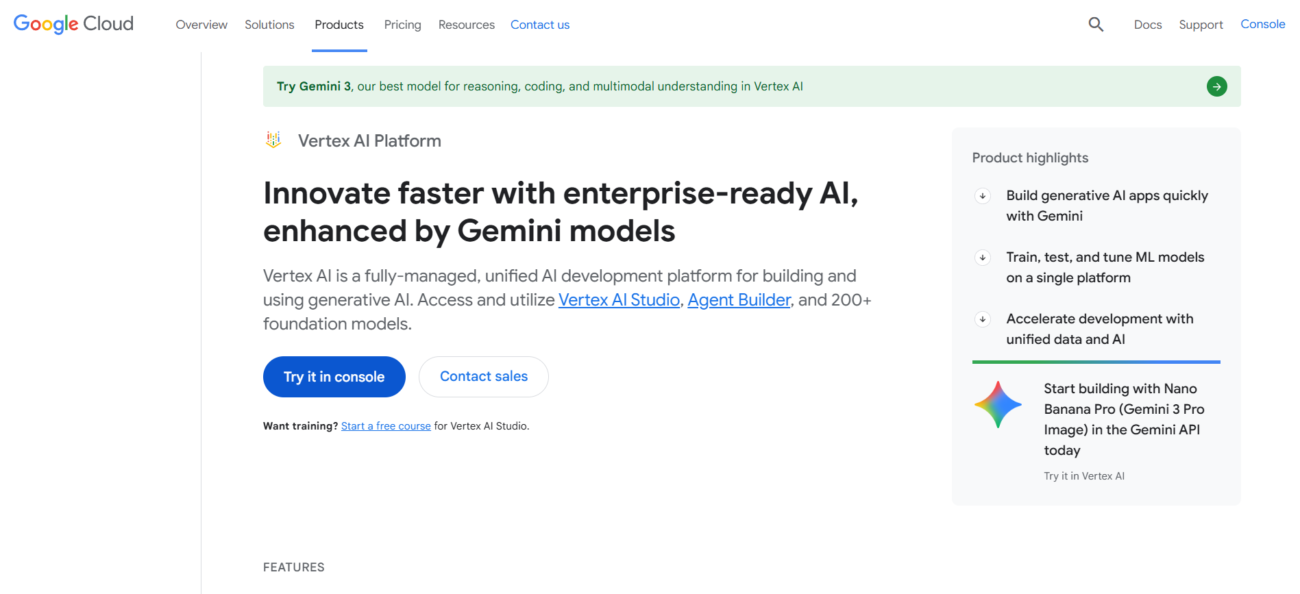
Google Vertex AI is an enterprise-grade machine learning (ML) and generative AI platform that unifies Google Cloud’s AI offerings into a single environment. In 2026, it serves as the core infrastructure for “The Agent Leap,” enabling organizations to move beyond simple prompts to creating complex, autonomous AI agents. The platform provides access to over 200 foundation models—including the Gemini 3 family, Imagen, and Veo—allowing developers and data scientists to train, test, and tune models on a single, scalable infrastructure.
Vertex AI is primarily accessed through the Web-based Google Cloud Console, which offers a graphical interface for managing projects, notebooks, and model deployments. Developers frequently use it on their Desktop via the Google Cloud SDK and CLI for local development and automation. Its capabilities are fully exposed through a robust API, facilitating deep integration into Web and Mobile applications. For teams requiring specialized environments, it offers Vertex AI Workbench, a managed Jupyter notebook service optimized for experiment tracking and MLOps.
Vertex AI is best known for its AutoML capabilities, which allow users without deep ML expertise to build high-quality custom models for images, text, and tabular data. It is highly regarded for its native integration with BigQuery, enabling “SQL-based ML” where users can build and deploy models directly on their data without migration. In 2026, it is recognized for the Vertex AI Agent Builder, a suite of tools that simplifies the creation of production-ready AI agents grounded in enterprise data and Google Search. Additionally, its Model Garden remains a landmark feature, providing a curated catalog of first-party, third-party, and open-source models for flexible enterprise adoption.

AI automation workflows automate tasks across tools and apps, helping teams reduce manual work and scale faster.

AI chatbots answer questions, support customers, and automate conversations across websites, apps, and messaging platforms.

AI code tools help developers write, debug, and understand code faster across the development process.
AI integrations connect AI tools with existing platforms to streamline workflows and automation.
AI natural language processing helps software understand, analyze, and work with human language.

AI team collaboration tools support shared workspaces and structured teamwork around AI workflows.
Automation AI tools help:
These tools streamline operations and help teams work more efficiently.
Development AI tools help:
These tools help teams build, test, and ship software more efficiently.
Education AI tools help:
These tools help educators and learners save time and improve educational results.
Startups AI tools help:
These tools help startups move faster and compete with limited resources.
Website creation AI tools help:
These tools help users launch and manage websites more efficiently.
Features:
Features:
Features:
Pricing information is provided for reference only and may change.
For the most up-to-date pricing, please visit the
official website
.





Leave a comment